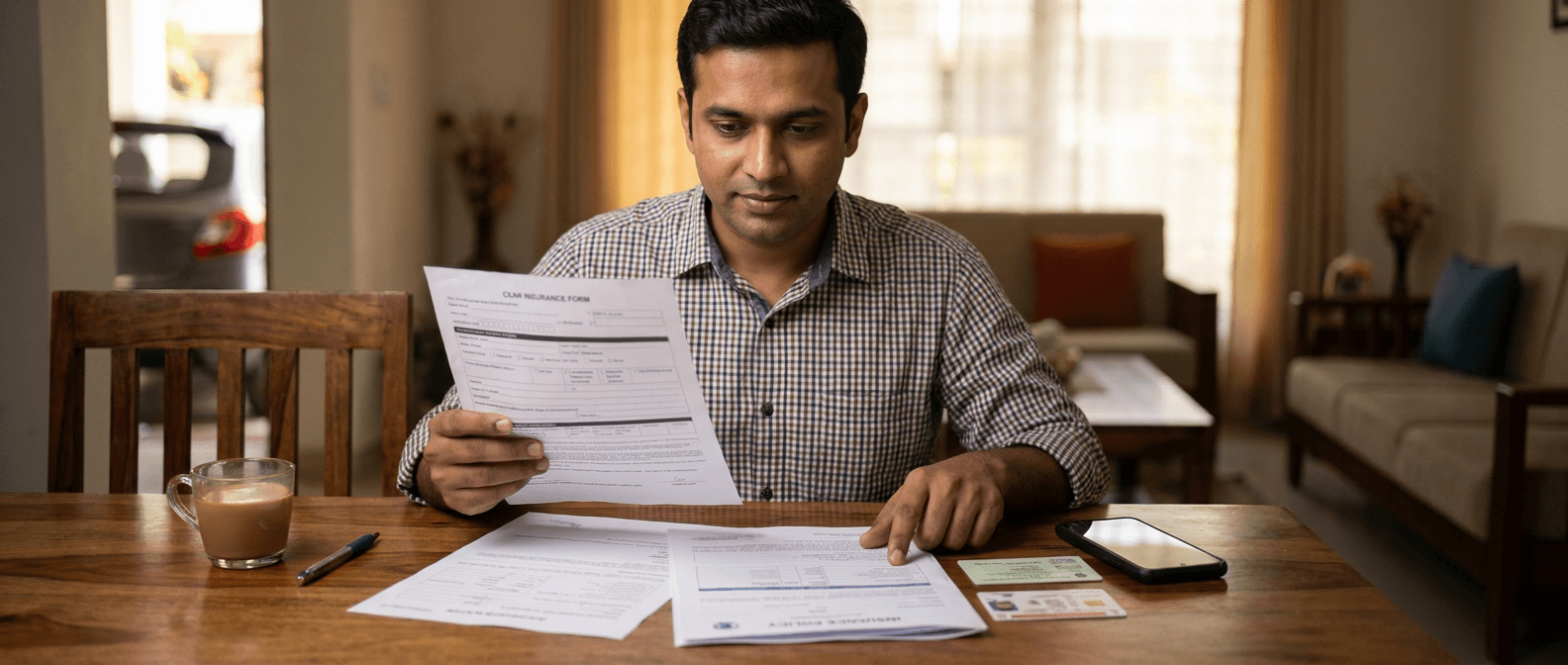
You can appeal a rejected car insurance claim if you selected the wrong No Claim Bonus (NCB). This is only allowed if the wrong NCB was declared as a genuine mistake and the insurer allows you to pay the premium difference. Incorrect NCB does not make every claim invalid, but intentionally mentioning wrong NCB can lead to claim rejection.
What is a No Claim Bonus?
No Claim Bonus or NCB is a discount offered by a car insurance company to the policyholder for not making a claim in the previous policy year. NCB belongs to the policyholder not to the vehicle. This means that if the policyholder goes 3 years without making a claim, and then switches their vehicle, they will be eligible to three-years worth of accrued NCB. Your car insurance premium has two components: the mandatory third party liability and the own-damage premium. NCB applies only to own-damage part of your premium. It does not reduce mandatory third-party premium.
| Claim-free period | NCB on premium | What it means |
|---|---|---|
| After 1 claim-free year | 20% | You pay 80% of premium before add-ons and taxes |
| After 2 claim-free years | 25% | You pay 75% premium before add-ons and taxes |
| After 3 claim-free years | 35% | You pay 65% before add-ons and taxes |
| After 4 claim-free years | 45% | You pay 55% premium before add-ons and taxes |
| After 5 or more claim-free years | 50% | You pay 50% before add-ons and taxes |
Does wrong NCB automatically cancel your car claim?
Wrong NCB does not mean your car insurance claim will be automatically rejected. If NCB error caused a reduction in own-damage premium and the insurer has not established fraud, the issue is corrected by paying the NCB difference.
Claim rejection is more likely when the insurer can show that the wrong NCB was not a clerical error or selection mistake but a misrepresentation. A misrepresentation is a false statement that affected car insurer's decision to issue the policy.
Can the insurer ask you to pay the NCB difference?
Yes, the car insurer can ask you to pay the NCB difference if it treats the wrong NCB as a premium shortfall rather than fraud. You can ask for the premium calculation and confirm that paying the difference will allow your claim to be reassessed.
Simple example
Let’s say a car's own-damage premium before NCB is Rs 12,000. You selected a 50% NCB, but the correct NCB was 20%
| Component | Calculation | Amount |
|---|---|---|
| Premium charged at 50% NCB | Rs 12,000 minus 50% | Rs 6,000 |
| Correct premium at 20% NCB | Rs 12,000 minus 20% | Rs 9,600 |
| NCB premium shortfall | Rs 9,600 minus Rs 6,000 | Rs 3,600 |
If your repair amount is Rs 80,000 and the insurer may ask you to pay the difference in premium, Rs. 3,600 to resolve the issue.
Get the rejection in writing
Ask your insurer for a formal letter stating the exact reason for rejection and how they calculated your NCB error.
Gather your NCB documents
Collect your previous policy schedule, renewal notice, or a claim-history letter from your previous insurer showing your true NCB status.
Offer to pay the difference
Write to the insurer explaining that the wrong NCB choice was an honest mistake. Offer to pay the unpaid premium amount, which is the NCB shortfall, and request that they process your claim.
Complain to the GRO
If the claims team refuses, email a formal complaint with your documents to the insurer’s official Grievance Redressal Officer. They are required to give you a decision within 15 days.
Use IRDAI's Bima Bharosa portal
If the GRO rejects your appeal or fails to reply within 15 days, file a complaint at bimabharosa.irdai.gov.in or call 155255.
Approach the Insurance Ombudsman
If the issue remains unresolved after 30 days, submit a free complaint to the Insurance Ombudsman at cioins.co.in. The Ombudsman's decision is binding on the insurance company.
Do not create a backdated explanation
If your insurer asks for a clarification, explain the error and attach documents. Do not submit a backdated no-claim declaration, altered policy or false NCB proof.
When should you appeal a claim rejected due to incorrect NCB?
You can appeal when the insurer has denied the claim, delayed a decision, or demanded a correction that you believe is wrongly calculated. Your appeal is stronger when you can show that the NCB error was accidental, immaterial to the claim event, or capable of premium correction.
| Appeal ground | Reason for wrong NCB selection |
|---|---|
| Genuine selection mistake | You did not intend to hide true NCB and are willing to pay the shortfall. |
| Intermediary or platform error | Wrong NCB was entered by an agent, dealer or broker despite correct information from you |
| No previous claim concealed | Previous policy record shows actual NCB you selected or shows no own-damage claims made |
| Disproportionate rejection | Rejection is due to a premium shortfall and insurer has not proven intentional misrepresentation. |
| Procedural gap | Insurer rejected the claim without giving clear reasons or relevant policy clauses. |
How to decide if you should appeal the claim decision?
Use this quick checklist before you appeal:
- Confirm the rejection reason: If the claim was rejected only because of the wrong NCB, ask the insurer for the rejection reason, policy clause and NCB calculation.
- Check whether it was a genuine mistake: If you picked the wrong NCB by mistake, ask the insurer to correct the premium and offer to pay the NCB shortfall.
- Collect proof of the correct NCB: Share your previous policy, renewal notice, NCB confirmation, and claim-history letter from the previous insurer.
- Escalate if the insurer refuses or does not reply: File a written grievance with the insurer's grievance redressal officer. If the claim is still being assessed, wait for a written confirmation.
- Escalate to IRDAI or Insurance Ombudsman: If you are unhappy with the insurer's final decision, escalate through IRDAI's Bima Bharosa channel or the Insurance Ombudsman.
What is the IRDAI grievance process?
The IRDAI grievance route starts with the insurer. You should first file a written complaint with the insurer's grievance redressal officer and keep the acknowledgement number.
- Write to the insurer's grievance redressal officer with the policy number, claim number, repudiation letter, correct NCB proof, and requested remedy.
- Ask specifically for one of these outcomes: premium correction and claim processing, withdrawal of repudiation, or a speaking order explaining why the insurer refuses correction.
- If the insurer does not resolve the grievance or you are dissatisfied with its final response, escalate the complaint through IRDAI's Bima Bharosa grievance platform.3
- Keep the IRDAI complaint number, insurer replies, and all attachments because the same file will help if you later approach the Insurance Ombudsman or Consumer Commission.
Key takeaways
You can appeal a denied car insurance claim if the dispute is about a wrong NCB entry and the insurer has not properly considered the facts.
The insurer may collect the shortfall in your premium due to the incorrect NCB and continue assessing the claim.
A genuine NCB mistake is different from intentionally declaring the wrong NCB, giving an incorrect previous claim history, or using forged NCB proof.
The grievance path usually starts with the insurer, then IRDAI's Bima Bharosa channel, Insurance Ombudsman, or Consumer Commission, depending on the dispute and remedy.
Frequently asked questions
Yes. Ask the insurer for the written reason, correct NCB calculation, and policy clause. If the wrong NCB was a genuine error, request premium correction and claim reassessment.
Not always. A wrong selection can be an error. It becomes more serious when there is deliberate false declaration, concealed previous claim history, or forged proof.
Cancellation depends on the policy terms, the facts, and whether the insurer treats the issue as misrepresentation. A correctable NCB shortfall does not automatically mean cancellation.
In some cases, yes. If the insurer treats the issue as a premium shortfall, it may ask you to pay the difference before processing the claim. Get that decision in writing.
No. NCB applies to the own-damage premium. It does not reduce the mandatory third-party liability premium.
A paid own-damage claim usually affects your NCB eligibility. If you selected an NCB that was not earned, the insurer may seek correction or may investigate non-disclosure.
Sources and references
- 1.India Motor Tariff, General Regulation 27, No Claim BonusMotor tariff framework for NCB slabs on own-damage premium.
- 2.IRDAI Protection of Policyholders' Interests, Operations and Allied Matters of Insurers Regulations, 2024Regulatory framework for policyholder protection, claims handling, and grievance systems.
- 3.IRDAI Bima Bharosa grievance platformIRDAI online platform for insurance grievance registration and tracking.
- 4.Insurance Ombudsman Rules, 2017Rules governing Insurance Ombudsman complaints, procedure, and monetary scope.
- 5.Consumer Protection Act, 2019 and revised pecuniary jurisdiction rulesConsumer dispute forum structure and jurisdiction limits.
About the authors

Nikhila PS
Written by · Senior Content EditorNikhila is a content creator with 6+ years in EdTech and motor insurance, turning complex policies into clear, engaging content. She enjoys exploring digital trends, social media, and art while planning her next short escape.

Rekhit Singh Kaushal
Reviewed by · Senior Director - Motor UnderwritingRekhit Singh Kaushal is Senior Director at ACKO, a leading digital motor insurance provider in India. With deep expertise in insurance strategy and innovation, he brings trusted insights on car and bike insurance to help drivers stay protected.